
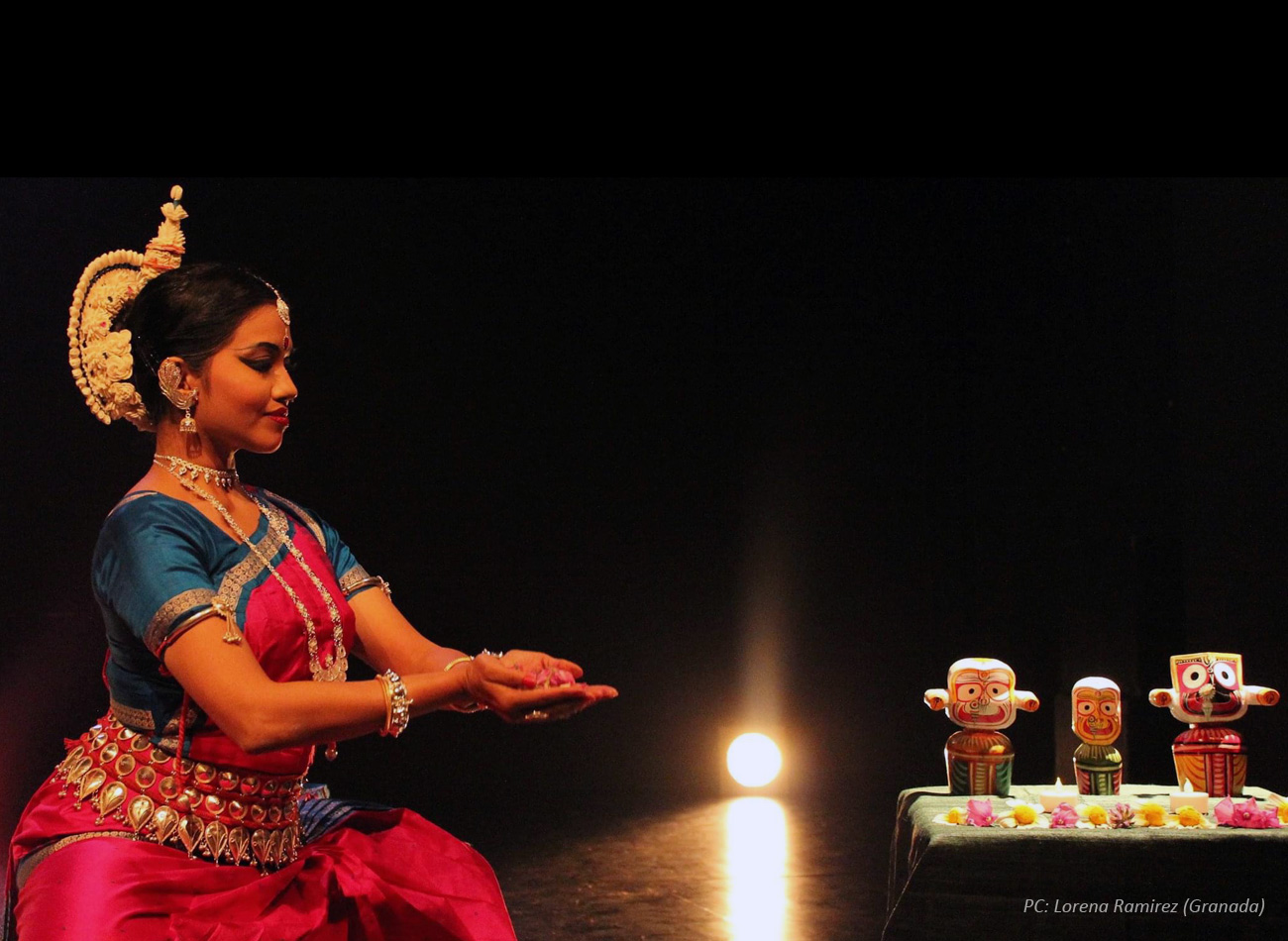
I consciously try to remain spiritually connected so that I can be a conduit for the same for the audiences.
[vc_row enable_arrows_animation=”no” css=”.vc_custom_1624007689940{padding-bottom: 5% !important;}”][vc_column][vc_column_text]
In conversation with SONALI MISHRA, World-renowned Odissi Dancer
[/vc_column_text][vc_row_inner css=”.vc_custom_1624007608524{padding-top: 3% !important;}”][vc_column_inner][vc_column_text]
THIS CANDID TALK WITH SONALI MISHRA TELLS US AN INSPIRING STORY OF HOW PERSEVERANCE AND PASSION CAN HELP ARTISTS OF INDIAN ORIGIN STAYING IN A FOREIGN LAND, ACHIEVE HER GOALS IN SPITE OF ADVERSE MARKET PRESSURES AND FACING RACISM. SONALI ALSO GIVES AN INSIGHTUL ACCOUNT OF THE INSPIRING INITATIVES SHE HAS TAKEN TO GROW US AN ARTISTE, WHILE ALSO TOUCHING UPON WIDE-RANGING FACETS THAT IMPACT ANY ASPIRING ARTIST TODAY. READ THE INTERVIEW
[/vc_column_text][vc_column_text]EDITOR’S NOTE: Globally renowned Indian classical dance exponent, Sonali Mishra was born and raised in the USA, where her parents emigrated to from Odisha in the late 1960s. She was initiated into Odissi in her early teens under Guru Smt. Chitralekha Patnaik, Guru Smt. Ellora Patnaik, and Guru Sri Devraj Patnaik. Since 1995 she has been travelling to Odisha for further training and refinement under Guru Sri Ramesh Chandra Jena, Guru Sri Bichitrananda Swain, and Guru Smt. Aruna Mohanty at the Orissa Dance Academy. She received additional guidance under Guru Smt. Nandita Behera in LA during that time. She continued her training In India at Srjan under Guru Smt. Sujata Mohapatra and Guru Sri Ratikant Mohapatra. Sonali is receiving additional guidance under Delhi-based Guru Smt. Kumkum Lal. Sonali has also completed 4 phases of the ‘Navarasa Sadhana’ actor’s workshop conducted by Kodiyattam artiste and scholar G. Venu in Kerala.
Sonali has performed as a soloist in numerous venues throughout the US, UK, Canada, India, Spain, Portugal, France, Germany, Austria, and Malaysia. She has also conducted a number of workshops and lecture-demonstrations at various schools and universities in cities throughout India, USA, and Europe. In 2014, Sonali founded an online quarterly magazine, Global Rasika, dedicated to cultivate critical thinking and discourse in the field of Odissi dance.
Sonali is a recipient of the ‘2020 Devi Award for Advancing Arts and Culture through Dance’ by the New Indian Express Group presented by the Honourable Chief Minister of Odisha Naveen Patnaik. She also received the ‘2018 Aarya Award for Women Acheivers’ by the Delhi-based Parichay Foundation.
Sonali received her BA in English from the University of Michigan and an MS in Public Policy and Management from Carnegie Mellon University. She relocated to India in 2011 when she got married, and is currently dividing her time between Vrndavan and Bhubaneswar.[/vc_column_text][vc_separator css=”.vc_custom_1624010429324{padding-top: 3% !important;padding-bottom: 1% !important;}”][vc_column_text]
THE SONALI MISHRA INTERVIEW
You are a blend of Indian culture and western education and way of life. How has this attribute impacted your journey as an Odissi exponent?
I think my journey as a dancer was shaped by my experiences as a minority growing up in the US. Having experienced racism at a very young age, dance was the main medium through which I could empower myself by connecting with my cultural identity and heritage. While I had a deep yearning to dance professionally, I found it difficult to even consider the possibility because the form, content, presentation and even semantics were so far removed from mainstream dance culture in the US. Producers and festival curators had very different ideas and aesthetics about dance and how it should be presented.
Being an artiste of the diaspora, particularly with roots in Odisha, I somehow felt a self-imposed responsibility to present Odissi in a way that I felt (in my understanding) could best showcase its form and essence. I was uncomfortable adapting Odissi (altering the costume, content, movement, or music) to meet the aesthetic demands of funders/festival curators. As a college student, and later when pursuing my Master’s degree, I began to understand more in-depth the challenges for minority artists in the US, from lack of representation in the mainstream, to decisions regarding allocation of support. I would continue to further research these issues later on in my career, which influenced my dance journey – I was keen to present the art as authentically as I could (to my understanding) without having to adapt it to ‘fit’ a particular aesthetic. To this day, my approach to presentation, even in the wording and imagery used in the marketing is carefully considered. So from the very beginning, I think my childhood experiences drove my educational and research interests, which shaped the direction of my dance studies and career.
“In my personal experience, there is a different kind of openness and an appreciation for Indian classical dance forms beyond mere (exotic) spectacle.”
[/vc_column_text][/vc_column_inner][/vc_row_inner][vc_row_inner css=”.vc_custom_1666666061339{padding-top: 3% !important;}”][vc_column_inner][vc_column_text]
SONALI MISHRA SELECT DANCE VIDEOS
[/vc_column_text][vc_empty_space height=”12px”][/vc_column_inner][/vc_row_inner][/vc_column][/vc_row][vc_row enable_arrows_animation=”no” css=”.vc_custom_1474291084926{padding-bottom: 20px !important;}”][vc_column width=”1/3″][vc_single_image image=”12191″ img_size=”350×220″ onclick=”custom_link” img_link_target=”_blank” link=”https://youtu.be/l_tMXIWdXfU”][vc_column_text]
Nagendra Haraya
[/vc_column_text][/vc_column][vc_column width=”1/3″][vc_single_image image=”12192″ img_size=”350×220″ onclick=”custom_link” img_link_target=”_blank” link=”https://youtu.be/GEpJNluSCcY”][vc_column_text]
Udayraag Dance Series
[/vc_column_text][/vc_column][vc_column width=”1/3″][vc_single_image image=”12193″ img_size=”350×220″ onclick=”custom_link” img_link_target=”_blank” link=”https://youtu.be/whRkiHE7txY”][vc_column_text]
130th Anuvartanam (In tune with the times)
[/vc_column_text][/vc_column][/vc_row][vc_row enable_arrows_animation=”no”][vc_column][vc_column_text]You have been performing prolifically at diverse prestigious stages globally. How do you think the ‘response to Indian classical dance forms has evolved in recent times?
In my personal experience, there is a different kind of openness and an appreciation for the dance form beyond mere (exotic) spectacle. I also think there is a growing interest in watching dance that is authentic. Audiences are also more informed, so there is less of a need to spoon-feed or cater to what we think they may want to see. I have always had full faith in the universality of these art forms despite perceived cultural barriers. Even if a piece is in Sanskrit or Odia, the audience is on the journey with me. Performing ‘Yahi Madhava’ will stir a response whether in Paris, Lisbon, or London, There was one instance in Berlin where the organiser forgot to distribute programmes prior to the performance. Despite not having a reference ‘guide’ the audience was fully engaged throughout the entirety of the show. It is especially heartening to see audiences expanding in the countries I continue to visit.
You have been regularly conducting arts-related workshops, lectures and demonstrations across the world. Are you satisfied with the responses these initiatives generally receive?
Definitely. Lecture-demonstrations allow the artiste to demystify and deconstruct the art form in real time. It is also a glimpse into the mechanics and context of the dance, which will enrich the experience for the audience, as was the case when I conducted a lecture-demonstration for the ‘Fall for Dance’ festival in New York City.
Another memorable experience was participating in the ‘India Quartet’ headed by the late Sitar artiste Pandit Subroto Roy Choudhury, with his senior disciple Indro Roy Choudhury and Tabla artiste Sanjib Pal. This initiative involved traveling to different schools in Innsbruck, Austria, to expose local schoolchildren to Indian classical dance and music. Children add a beautiful energy and excitement to the workshop experience altogether – I was thoroughly impressed by their level of interest and engagement. Another initiative closer to home is the Spic-Macay Workshop Demonstration series, spearheaded by Kota-based Mr. Ashok Jain. The concept was somewhat similar, WD format brought professional dancers to schools in urban and rural areas throughout India to showcase Indian classical dance to young children who may not have access to these art forms. Presenting in these schools, some which were operating with the most minimal of resources, was a truly humbling experience for me.
As I love to teach, workshops are also a wonderful way to engage with students, it is just as much a learning experience for me as it is for them, though I never feel the time is enough. I particularly enjoy the process of teaching abhinaya and developing exercises for students to learn how to emote with the face and body. The most rewarding experience is witnessing the students’ growth and interest year after year.
Do you feel experimental creative productions are better equipped to give a social message more effectively? Can these be leveraged to fructify social causes?
I think over the years we have been witnessing a blurring of the line between ‘classical’ and ‘experimental,’ Many dancers are exploring social issues through a classical aesthetic. It is really up to the artiste, his/her creative ability, understanding of the issue at hand, and the sincerity of intent rather than the medium itself.[/vc_column_text][vc_row_inner css=”.vc_custom_1624012669427{padding-top: 3% !important;}”][vc_column_inner width=”1/2″][vc_gallery interval=”5″ images=”12195,12196,12197,12198,12199″ img_size=”450×450″ onclick=”” css_animation=”fadeIn”][/vc_column_inner][vc_column_inner width=”1/2″][vc_column_text]Can technology and social media play a vital role in promoting Indian classical dance forms? Can the arts community or artistes in real terms, leverage these to drive their artistic passions forward?
Yes and no. I would say social media has definitely allowed for greater accessibility to Indian classical dance, so there has been exponential growth in audiences (both online and in physical spaces) around the world. So yes, social media has significantly increased the appetite for Indian performing arts.
For artists, social media have democratised the field of the performing arts by removing or creating very low barriers for entry, allowing artistes to present their content with greater visibility to help build a larger following.[/vc_column_text][/vc_column_inner][/vc_row_inner][vc_row_inner][vc_column_inner][vc_column_text]The downside of social media is that it tends to get oversaturated (‘internet fatigue’). Social media also does not filter for quality, so a mediocre artiste can cultivate greater traffic (in the form of shares, ‘likes’ and followers) with the right algorithm, creating a perception of excellence, while a superior artiste with less-sophisticated social media skills may have the opposite effect. Thus, in a way social media has lowered the bar for quality by creating a system where the artist is as good as his/her marketing.
These days it is not easy to establish a professional arts career, and sometimes social media can add to the clutter. Even the most talented and hardworking of artists will face difficulty without the right kind of support and mentorship within the ecosystem.
What have been your most enriching experiences as a researcher in arts?
I have found the topics that I have researched the most exciting: The impact of globalization on local cultures, the role of culture in urban and regional economic development, minority arts practices in the US, are some of the issues I have explored. I thoroughly enjoy the process of research, from gathering information, to working with data and sitting to write the final report. Being an artist is an added advantage because it allows for a fresh perspective and a different layer of context to the research.
How has this research experience enhanced you as an artiste?
Being a researcher has heightened my awareness of larger scale issues pertaining to culture, race, and globalization, which has made me that much more committed to deepening my practice and presenting it responsibly. I also understand the role I play in the larger context of arts practice in India and in the West. So my approach to dance is not casual or self-indulgent, I make very conscious choices and always keep the larger picture in mind.
On a slightly different but related note, as we have recently relocated to Vrndavan a few months back, I find that most of my reading these days is anything related to bhakti marg, which has made me re-examine my own studies in Odissi history and development. Additionally, it has given me a deeper insight into some of our traditional dance pieces, so it is nice to be able to look at them with a fresh perspective.
What were the highlights of your research on the topic ‘international culture’?
One of my pet projects was an online initiative ‘Global Rasika’ which I launched in 2014. The intention at the time was to foster critical thinking in the field of Odissi – at the time there were a number of PhD students and researchers visiting Odisha to conduct their research, but rarely did we get an opportunity to read or access any of this research. I had originally envisioned Global Rasika to be a unique platform where we could take dance out of the classrooms and engage in a very different kind of conversation – because in my mind, there were so many questions and issues around dance, identity, and tradition that remained unanswered. In hindsight, I think Global Rasika emerged from my internal conflicts regarding some of these larger issues. It is important to mention here that Global Rasika is currently on a pause, but it is expected to return in the future.
“If they say ‘God is in the details,’ then Guru Kelucharan Mohapatra’s’ work is to experience God. The depth of emotion and nuance in his choreography (and music), is testament to his genius.”
You were already a globally renowned Odissi exponent before you started your association with the legendary Guru Kelucharan Mohapatra’s Srjan. How has experience with Srjan transformed you as an artiste?
That is a very generous compliment, but I always consider myself a ‘work in progress.’ I am blessed to have had trained with extraordinary artistes, each of whom has played a very important role in making me the dancer I am today.
I have always been captivated by the depth and intricacy of Guru Kelucharan Mohapatra’s dance pieces. His artistry reflects his mastery as a multidimensional artist – painter, mardala player and dancer. I had always wanted to study under him at some point, but he had passed on before I had the chance.
The experience of learning Odissi at the home of the legendary Guru was a very unique one. The classroom is an extension of the residence, so there was a very different kind of access and interaction with our Gurus. We were not just students, we were part of the extended family. Tasked with the responsibility of carrying Guruji’s legacy forward, Guru Ratikant Mohapatra (Shibubhai) and Guru Sujata Mohapatra (Sujata Apa) maintained a culture of hard work, discipline, and focus. Any casual or haphazard approach to dance was strongly discouraged.
The training itself allowed for a deeper insight into the mechanics of Guruji’s style. If they say ‘God is in the details,’ then Guruji’s work is to experience God. The depth of emotion and nuance in his choreography (and music), is testament to his genius.
During my time there, Sujata Apa took me under her wing, training me to be a soloist. A demanding teacher, she really pushed me beyond what I ever thought was possible, and in the process raised my own expectations of myself. In retrospect, I think she could foresee the challenges I could potentially face in the future if my dancing abilities were not up to the mark – despite being a ‘foreign student’ I did not resemble what was commonly understood as ‘foreign.’ I would always be compared to local dancers, without the advantage of having years of training and performance experience in Odisha/India. In my situation, there was no alternative but to work twice as hard as the others. Sujata Apa firmly believed that it was hard work – not networking, marketing, or contacts – that should open the door to success. As students, we spent most of our time with her, which allowed us access to her on and offstage. I can only describe Sujata Apa as a force of nature – In addition to managing her home and her professional career with aplomb, she was a very dedicated teacher.
Shibubhai, with whom I have also been privileged to study with, is another force to be reckoned with – an equally demanding teacher who expected our full focus and concentration in the classroom. A master Mardala artiste, Shibubhai taught us the nuances of rhythm and how a movement should be rendered keeping these cadences in mind. I was always amazed by his clarity of thought and meticulous attention to detail – not only in dance, music, and choreography, but also as a festival curator and now Dean of Arts, Communication and Indic Studies at Sri Sri University. Similarly, despite effortlessly managing many roles and responsibilities, Shibubhai will always find the time to guide and mentor his students both inside and outside the classroom.[/vc_column_text][/vc_column_inner][/vc_row_inner][vc_row_inner css=”.vc_custom_1666766562551{padding-top: 5% !important;}”][vc_column_inner width=”1/2″][vc_single_image image=”12205″ img_size=”450×324″ add_caption=”yes”][/vc_column_inner][vc_column_inner width=”1/2″][vc_column_text][/vc_column_text][vc_column_text]What kind of support have you received from your family to pursue your artistic dreams? What thoughts you would like to share with parents of artists who also look forward to shining in a completely unrelated profession or field – who may think that pursuing arts is a waste of time and energy?
I was very fortunate that my parents have always been very supportive of my dance journey. My parents gave my Gurus and I a lot of space, without getting involved in the learning process. From the very beginning they were very clear that whatever opportunities came my way would have to be earned through hard work and merit.[/vc_column_text][/vc_column_inner][/vc_row_inner][vc_row_inner css=”.vc_custom_1666766650808{padding-top: 3% !important;}”][vc_column_inner][vc_column_text]There was never a sense of entitlement, nor did they ever try secure performance opportunities on my behalf. This value system kept me grounded and take ownership of my dance from an early age. My other major support is my husband. Being an entrepreneur, our internal wiring is very similar so we intuitively understand one another’s idiosyncrasies which is important in this type of relationship (where both partners are creative). Besides being my sounding board for any new project, he has always given me the space to develop as an artiste.
For parents of artists, I would advise them to give their children the space to grow and take responsibility of their dance – this begins with their practice. It is also important to set very realistic expectations about the field itself and weigh the pros and cons of pursuing a performing arts career before moving ahead.
Can performing arts play a vital role in helping a person excel in other fields or professions?
Absolutely. The focus, discipline, and concentration that is required in the initial stages of training is a wonderful tool in any field. And as one continues their artistic path they will continue to develop new skills – be it writing, public speaking, working in a group, etc. – all of which are applicable in school or work. The demands of a performing arts career also equip one with a very different kind of physical and mental endurance. While living in New York, I was pursuing parallel professions in research and in dance. I had developed a strong sense of discipline during my dance training, so I when I was working full time I would get up at five, walk ten blocks to the studio and practice for two hours, work a full day in the office, and then teach my classes two or three times a week, sometimes performing on weekends. This was my ‘normal’ because I was already accustomed to gruelling practice and performance schedules in India.
“I would hope in this lifetime to be able to dance and choreograph in such a way to take the audience on this inward journey where time and space cease to exist.”
What are your ultimate dreams and ambitions in the world of performing arts? And what steps are you taking to reach ‘there’?
This question has always eluded me, because the underlying goal from the very beginning has been to continue to delve deeper and deeper into my arts practice and continue to evolve artistically and spiritually (I believe the two go hand in hand). I would hope in this lifetime to be able to dance and choreograph in such a way to take the audience on this inward journey where time and space cease to exist. The artists I have loved and admired the most have been the ones who have the ability to surpass all barriers and bring the audiences to a different dimension.
Additionally, it is extremely critical that I continue to remain a loyal ambassador of Odissi’s unique aesthetic – the lyricism, grace, nuance and emotion – and to give more and more people the joy of that experience. Along those lines, I hope that I can focus my research efforts more exclusively on Odissi and participate in the global dialogue regarding the same.
At this phase in my life and in my career, I will consider it as an achievement if I can remain true to the above ideals as a performer, choreographer and researcher.
I do realise that this is a lifelong endeavour (perhaps several!), but I keep a very routine lifestyle which includes daily practice, prayer, yoga, reading, writing and meditation. As a dancer. I consciously try to remain spiritually connected so that I can be a conduit for the same for the audiences.
Your opinion on how the performing artist ecosystem can be enhanced?
I would encourage young artists to take an active role in driving change in the cultural landscape to create a more robust, inclusive, and equitable dance/cultural ecosystem. The late Toronto-based Bharatanatyam/Odissi artiste Guru Smt. Menaka Thakar from Canada was tireless in her efforts to ensure that Indian dancers had fair share of government allocated funding for cultural activities. Artists have the power to drive change, but it is an effort that requires a lot of patience and persistence. There are a lot of intrinsic inefficiencies in the dance ecosystem currently and thus plenty of opportunities to democratise it – by creating new organizations, providing innovative allied services, spreading awareness, etc. I will encourage dancers to go beyond dancing alone and take inspiration from people like Menakadi to explore one or two areas of interest to expand the frontiers of the overall cultural landscape.
And finally, what message or advice you would like to share with young, aspiring artistes?
I would emphasize the importance for young dancers to have a sense of self and understanding of who they are as artists. These days there is a lot of pressure for dancers to be ‘relevant’ in content and presentation. I would advise young artists to define their own version of relevant, rather than trying to fit into others’ definition. And that may not happen immediately, it may take some time to explore. I also think it is important for dancers to not only develop clarity around their professional goals, be it fame, monetary success, artistic fulfilment – but to also determine what they are prepared to do to achieve the same. When artists do not have this clarity, they try to adapt to others’ expectations – artistically and professionally – at the cost of their authenticity, which is very difficult to sustain. Sometimes taking a step back to reflect and know oneself (even at the risk of being ‘irrelevant’ and forgotten for a time) to develop goals that are aligned to one’s value system can be a blessing in the long run.
I would also like to emphasise the importance of prioritising one’s mental health. Thankfully, conversations around mental health are becoming more normalised in today’s generation. The demands of the performing arts field can add many layers of stress (and potential injury) without the tools to handle it effectively. Recognizing mental health triggers and using appropriate tools to navigate through the stressors can help manage anxiety and depression.[/vc_column_text][/vc_column_inner][/vc_row_inner][vc_separator css=”.vc_custom_1624011263768{padding-top: 3% !important;padding-bottom: 3% !important;}”][/vc_column][/vc_row][vc_row enable_arrows_animation=”no” css=”.vc_custom_1474355814165{padding-bottom: 10px !important;}”][vc_column][vc_column_text]
CONNECT WITH SONALI MISHRA ON
Website | Instagram | Facebook
DID YOU LIKE THIS ARTICLE? WRITE TO US AT
support@indiansoundsandteps.com
[/vc_column_text][/vc_column][/vc_row]