
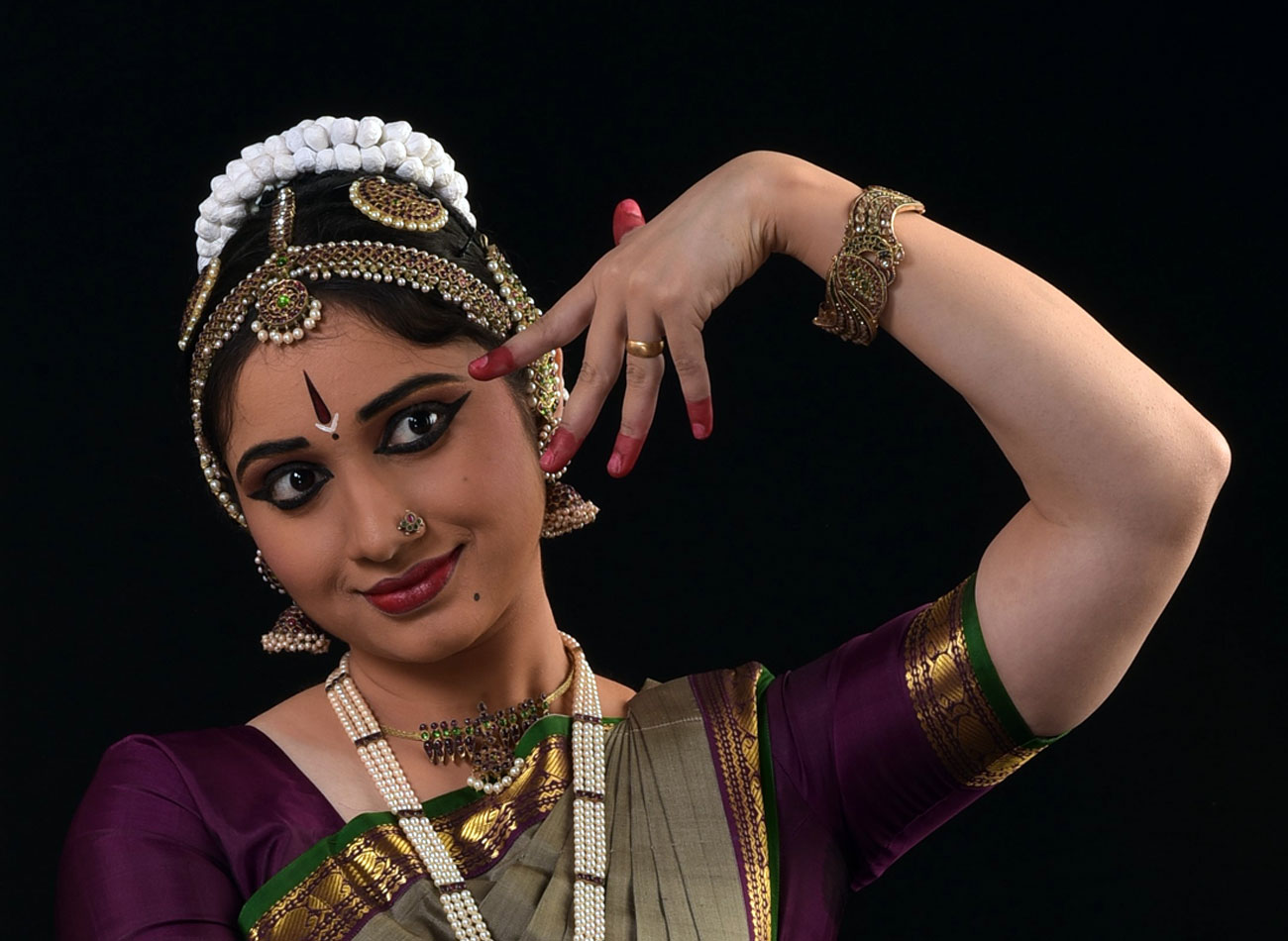
The performance actually happens inside the spectator. No performance is complete without the viewer relishing it.
[vc_row enable_arrows_animation=”no” css=”.vc_custom_1624007689940{padding-bottom: 5% !important;}”][vc_column][vc_column_text]
An interview with MEERA SREENARAYANAN, Renowned Indian Classical Dancer
[/vc_column_text][vc_row_inner css=”.vc_custom_1624007608524{padding-top: 3% !important;}”][vc_column_inner][vc_column_text]
IN THS INTERVIEW WITH INDIAN SOUNDS & STEPS, MEERA SREENARAYANAN SHARES HER INSIGHTFUL AND RESOURCEFUL REASONINGS TO MAKE IT AMPLY CLEAR THAT THERE IS A LOT MORE TO PERFORMING ARTS THAN JUST ‘PERFORMING’ AND ‘ARTS’. AND HOW IT SILENTLY PLAY A CRTICAL ROLE IN MAKING ITS PRACTITIONERS BETTER PERSONS, BETTER PROFESSIONALS AND BETTER CONTRIBUTORSTO THE SOCIETY.
[/vc_column_text][vc_column_text]EDITOR’S NOTE: Meera Sreenarayanan is a globally recognized dancer, specializing in the Indian classical dance form, Bharatanatyam. She hails from Guruvayur in the South Indian state of Kerala.
Meera had learnt under the tutelage of noted dance exponents Sri Prakash, Sri RLV Anand and Acharya Kalakshetra Nirmala Nagaraj. Currently, she is exploring the art and abhinaya under the able mentorship of the eminent dance guru, Acharya Indira Kadambi. She has many performances (in India as well as abroad) and highly acclaimed awards to her credit. ‘Harini’, a well-received and appreciated thematic Bharatanatyam solo creation, conceptualized and choreographed by Meera for the Natyarangam of Narada Gana Sabha, Chennai, has proved her caliber as a choreographer as well. She has been constantly receiving rave reviews for her performances from leading art critics and media. She has been an actor in a few feature films.
A graded artiste of Doordarshan, Meera is also a recipient of the Centre for Cultural Resources and Training (CCRT) Young Talent and the National Council of Educational Research and Training (NCERT) Creative Talent scholarships. She was chosen as the best junior dancer at The Music Academy Madras Dance Festival 2019.
Meera also holds a double degree of post-graduation in Bharatanatyam and Physics from the University of Madras[/vc_column_text][vc_separator css=”.vc_custom_1624010429324{padding-top: 3% !important;padding-bottom: 1% !important;}”][vc_column_text]
EXCERPTS FROM THE MEERA SREENARAYANAN INTERVIEW
IS&S: How do you think the ‘global’ response to Indian classical dance forms have changed or evolved in recent times?
MS: I have never felt the need to distinguish between the audience in India and abroad. I strongly believe that dance has already broken those barriers and walls that separate us from each other in terms of language or geography, years ago. Dance today is a universal language.
If a German-speaking lady, who don’t have any dance background, could tear up watching a piece in Malayalam (an instance that happened when I performed in Japan), it doesn’t matter who or where you are! The only thing that matters is whether you have some time and mind to watch it attentively.
Maybe, now that it has come to a state where everything is on online platforms, the reach is wider and vast. More people are being introduced to the Indian classical art forms which is a good thing.
IS&S: You have also focused on performing arts for social awareness and causes. Do you feel this aspect has been largely unexplored by the performing arts community?
MS: I am not sure whether I am experienced enough to answer this. Only recently I had done a production that could come under the umbrella of social awareness, for the Erasing Borders festival organized by the Indo- American Arts Council. It was a piece on how our minds are not really independent, though we were declared as an Independent country over 75 years ago. As citizens, unless we are free from the shackles of our own thoughts, we will never be able to solve any issues concerning our country and the world.
I had been part of certain fundraising workshops and programs for organizations that were working for the Covid-relief funds and betterment of underprivileged artists. The amount of work they did was humongous. I realized that even a single person can make big differences in the society, especially artists. They have the plectrum to strike a chord in others and help to connect everyone at an emotional level as well.
I should admit that the pandemic has made me look closer at people and their lives. And yes, such awareness projects were always there and will be even more because we need them – what better way other than performing arts to reach out to people.[/vc_column_text][/vc_column_inner][/vc_row_inner][vc_row_inner][vc_column_inner][vc_column_text]
MEERA SREENARAYANAN SELECT DANCE VIDEOS
[/vc_column_text][vc_empty_space height=”12px”][/vc_column_inner][/vc_row_inner][/vc_column][/vc_row][vc_row enable_arrows_animation=”no” css=”.vc_custom_1474291084926{padding-bottom: 20px !important;}”][vc_column width=”1/3″]
[vc_column_text]
Performance at The Madras Music Academy 2022
[/vc_column_text][/vc_column][vc_column width=”1/3″]
[vc_column_text]
Śiva – The Better Half of Śakti
[/vc_column_text][/vc_column][vc_column width=”1/3″]
[vc_column_text]
Sakhi Hey Ashtapadi
[/vc_column_text][/vc_column][/vc_row][vc_row enable_arrows_animation=”no”][vc_column][vc_column_text]IS&S: Young, talented seeking instant ‘success’ or ‘recognitions’ by fighting it out in performing arts competitions and / or social media has become the norm of the day? Do you think this is a healthy trend?
MS: The word ‘success’ has a varied meaning. My definition of success is not necessarily yours. So if this kind of instant temporary recognition is what they seek, and if they are happy with it, I don’t think it’s wrong. But a true artist is always the one who feels responsible to deliver art with the purest intention. Sincerity and perseverance are two sides of the coin called Art, according to me. Patience is another name for art. Recognition is just a co-product, which happens if it is meant for you. That’s all. I say this because there are a huge number of talented beautiful artists who are not even famous but practice their art religiously. Finally, it filters down to a person’s mental satisfaction.
One request I have for them is to make sure you set their aim high because art can give you much more than these materialistic pleasures.
“A true artist always feels responsible to deliver art with the purest intention. Sincerity and perseverance are two sides of the coin called Art.”
[/vc_column_text][vc_row_inner css=”.vc_custom_1624012669427{padding-top: 3% !important;}”][vc_column_inner width=”1/2″][vc_gallery interval=”5″ images=”11945,11942,11941,11943,11944″ img_size=”360×450″ onclick=”” css_animation=”fadeIn”][/vc_column_inner][vc_column_inner width=”1/2″][vc_column_text]IS&S: How does your love and deep knowledge of science help you in adding value to your performing arts initiatives?
MS: Choosing physics was the best thing I did in my life. I say this because I didn’t choose dance, dance chose me. Being a science student has always helped me to look at things logically as well. To ask the right questions to oneself and others. Being able to think critically and systematically during the process of induction and deduction. And when sometimes logic and aesthetics fail to go hand in hand, I enjoy their tussle with uttermost curiosity because that’s when certain Eureka moments happen. I am not sure how to explain them in words.
While the understanding of physics excites me about the tiniest to the enormous things in this universe, dance takes me to a space where these exist and don’t exist at the very same time. One can only feel electrified then![/vc_column_text][/vc_column_inner][/vc_row_inner][vc_row_inner][vc_column_inner][vc_column_text]IS&S: How far has your experience and opportunities as a dancer, helped you in alternate careers as an actress and anchor, among others. Is it easy for a good dancer to be a good actor as well?
MS: I don’t think I deserve the ‘actor’ tag. It just happened. I am sure they called me because I was a dancer. So all the credits go to dance alone.
Acting in front of a camera is a completely different league. On stage, we are used to exaggerated movements, while for the camera it may seem heavy. So even a twitch in the eyebrow has to be under control. So it’ not not necessarily a good dancer has to be a good actor. But one who has complete awareness of one’s body and mind can easily switch from stage to camera.
“If youngsters are able to see the science in the art and the art in the science, they can become better individuals, and see the world in a better and fresh perspective.”
IS&S: Could you please throw light on your ambitious venture of bringing together students of science and art streams? How will this benefit the stakeholders from both sides?
MS: What I really want is to inculcate sensitivity to perceive beauty in and around oneself, in the kids. Life is much more than books and exams. As I said, science can create curiosity, while art can indulge them in aesthetics. If they are able to see the science in the art and the art in the science, I believe, they can become better individuals, and see the world in a better and fresh perspective.
The idea is shaping up well. If everything goes well, it will see the light of day soon.
IS&S: Do you think performing arts can play a crucial role in helping a person excel in other fields or professions?
MS: Of course! When you become a dancer, you are not trained to just dance. You get a disciplined mind and life. You are being trained to multifunction – because when you dance one ‘adavu’ itself, you need to be aware of how your eyes, hand, feet are coordinated to the rhythm. This is the simplest example I can give. You are trained to memorize hundreds of compositions. You are trained to see and feel things from others’ perspectives in ‘abhinaya’ classes, thus making one sensitive to others as well. Aren’t these the requisites for any other profession?
And I have seen how beautifully this art has helped many differently-abled children to become better at what they do. I am sure that dance is what helped me to better myself in my academics too. I am ever grateful for this art. The idea of bringing art and science together as told before is also to plant the right seed in kids for them to nourish and flourish in their fields of interest.
IS&S: What’s the kind of support you have received from your family to pursue your artistic passions? What thoughts you would like to share with parents of artists who also look forward to shining in a completely unrelated profession or field
MS: I have received only support and nothing less than that from my parents and now my husband. I don’t know what made my parents think that I would become a dancer when I was a kid itself. They really believed I would. So at every turning point of my life including marriage, they made sure I and my dance were safe. And I am most grateful to one thing they were adamant about, that I should learn dance for the sake of learning it and not to achieve any prize or accomplishments. And that’s what took me from Guruvayur to Chennai. It is not easy to be a parent to an artist. It is even more difficult to be a husband of an artist. Just because they play their roles with ease and love, I am still dancing. It’s a lot of hard work for them too.
For other parents, I have a request that once they make sure that their children are in a safe set of intelligent hands, then stay put and trust the process.
IS&S: What are your ultimate dreams and ambitions in the world of performing arts? And what steps are you taking to reach ‘there’?
MS: I am a person who goes with the flow and does what I think is the best at the moment. My goal is not something that is tangible and I don’t know how many lifetimes it will take to reach there. And what steps am I taking to reach there? I am dancing!
IS&S: And a final one. Is there a concept called a ‘complete dancer’ or a ‘complete performer’? What’s your take on this?
MS: Well, to answer this, let me share a thought that came to me recently. After every performance, I get varied responses from the audience. Some would have loved the entire performance in general. There would be one single piece that stood out for a few of them. A number of them would have loved the ‘abhinaya’ and others, ‘nritta’. Many would have loved one aspect of the entire performance, say for example the neatness, control, or maybe the idea behind each of the compositions. And some would not even have liked anything about the performance. The point is that an artist has no complete control over what the audience must see or like in his/her performance. Though artists create an audio-visual experience for them, the performance actually happens inside the spectator. The fruition of a performance, lies entirely with the spectator – as the ‘sastra’ also states. No performance is complete without the viewer relishing it. It is the expertise of the audience in the field, their state of mind at the moment they watch, and the ability to be open and receive without judgment, that decides what kind of performance happens inside them. So if you see, the audience is the one who actually does all the work to take performance to its fruition.
Then what does an artist do? They just have “to be” on stage – “let it go and just be.” And trust me when I say, it is the most difficult thing to accomplish – “to be there, at the moment, to be vulnerable to that moment, to be true! When I contemplate, all this training and ‘sadhana’ we undergo, is to achieve that level of ‘surrenderance’ to the known to the unknown.[/vc_column_text][/vc_column_inner][/vc_row_inner][vc_separator css=”.vc_custom_1624011263768{padding-top: 3% !important;padding-bottom: 3% !important;}”][/vc_column][/vc_row][vc_row enable_arrows_animation=”no” css=”.vc_custom_1474355814165{padding-bottom: 10px !important;}”][vc_column][vc_column_text]
CONNECT WITH MEERA SREENARAYANAN ON
Facebook | Facebook Profile | Instagram | YouTube
DID YOU LIKE THIS ARTICLE? WRITE TO US AT
support@indiansoundsandteps.com
[/vc_column_text][/vc_column][/vc_row]