
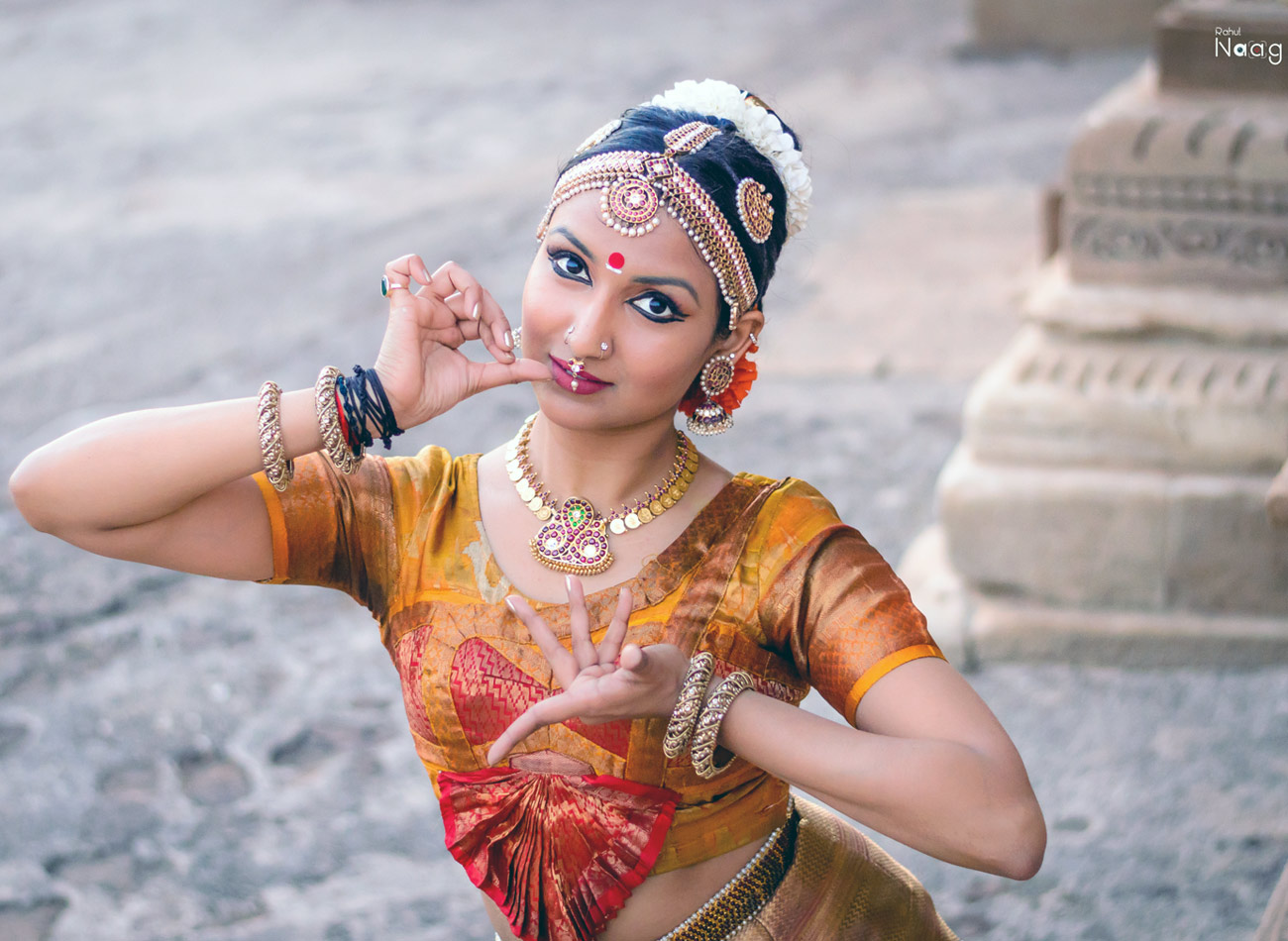
Translation over fusion is my undeterred approach to promote the Indian arts’ richness and distinctiveness
[vc_row enable_arrows_animation=”no” css=”.vc_custom_1624007689940{padding-bottom: 5% !important;}”][vc_column][vc_column_text]
An article by BHAVANA REDDY, Globally Acclaimed Performing Artist
[/vc_column_text][vc_row_inner css=”.vc_custom_1624007608524{padding-top: 3% !important;}”][vc_column_inner][vc_column_text]
IN THIS EXCLUSIVELY ARTICLE FOR INDIAN SOUNDS & STEPS, BHAVANA REDDY PUTS FORWARD A COMPELLING CASE FOR PRESERVING THE UNIQUE BEAUTY AND RICHNESS OF INDIAN ARTS AND CULTURE. READ ON …
[/vc_column_text][vc_column_text]EDITOR’S NOTE: Bhavana Reddy is an internationally acclaimed young Kuchipudi Indian classical dancer, and the younger daughter and disciple of the legendary dancing couple Padmabhushans Drs. Raja Radha and Kaushalya Reddy. She is a recipient of the Government of India’s coveted Sangeet Natak Akademi’s Bismillah Khan Yuva Puraskar and has received Lifetime Award for Contribution to Kuchipudi Dance by Telugu Cultural Association, Houston Texas, FICCI Young Women Achievers Award, Femina North Powerlist Award, to name a few. She is also an empanelled artist with India’s esteemed ICCR and Doordarshan.
Nearing three decades of performances, she frequently tours the USA, Europe, South East Asia and the UAE. She has experience performing for prestigious venues, occasions and dignitaries. To name a few – MIT and Peabody Essex Museum, Boston; Singapore Victoria Theatre, Khajuraho Dance Festival, Music Academy Chennai, Elephanta Festival, Konark Dance Festival as principal soloist for her parents Dr.s Raja Radha Reddy (Kuchipudi doyens and Padma Bhushan awardees).
Bhavana started her Kuchipudi formal training at the tender age of 4 from her illustrious parents Dr.s Raja Radha Reddy. Her Solo performances/tours include Temple of Fine Arts Malaysia, Indonesia, Kala Academy, Goa, Mudra Festival NCPA, Mumbai Sanskriti Festival, Kalidas Samaroh Nagpur, Yagnaraman Festival Krishnagana Sabha, Spic Macay Uttarakhand Tour and so on. For the 70th Independence Day Celebrations of India, Bhavana was invited by the Embassy of India, USA and Kennedy Center Washington for a full length solo evening recital of Kuchipudi Dance afore the Foreign Minister of India and esteemed ambassadors of neighbouring nations.
In 2020, she was invited for the prestigious Kylian Foundation Residency, Netherlands (awarded to the likes of Alvin Ailey Dance Company, USA) to create a new work with Artistic Director Leo Korzo for the India Dans Festival, Korzo Netherlands. She was invited to choreograph Kuchipudi and star in the production of Los Angeles Philharmonic Orchestra, ‘Stravinsky’s Rite of Spring’ at the prestigious Walt Disney Concert Hall Los Angeles in Dec 2019. Bhavana is unique in her generation of dancers having an education and command over Kuchipudi Indian Classical Dance, Carnatic Music and Western Contemporary Music.
Bhavana graduated from the Musicians Institute in Hollywood, California with an Associate of Arts Degree in Vocal Performance. She was the recipient of the Outstanding Artist Award in the program of Independent Artistry. She began learning South Indian Classical Carnatic vocals at four years old from Guru Kannakumar, and subsequently Durga Prasad from whom she also learned Carnatic violin till her late teens. During college, Bhavana learnt from All India Radio Director Shri K. Vageesh under whom she still learns vocals. As an international artist, having released a solo EP Tangled in Emotions and has sung the title track (The End) on Hollywood production, Joy Ride 3: Roadkill. Bhavana has performed at the Grammy Awards After Party.
During the pandemic she has done workshops / lec dems / concerts for the Indian Embassy USA, Consulates of India in Germany, San Francisco, Indian Embassy Denmark, Spic Macay India and so on. In 2020, She founded an International Center for Kuchipudi Dance and has been teaching numerous dedicated students from the USA, Europe, UK, India, Singapore and UAE. She has earned respect for herself world over as a magnanimous solo artiste in the young generation of Kuchipudi dancers and has dedicated her life in the service of Kuchipudi dance.[/vc_column_text][vc_separator css=”.vc_custom_1624010429324{padding-top: 3% !important;padding-bottom: 1% !important;}”][vc_column_text]
THE ARTICLE
Fusion has many connotations. And the most common is something I am not a fan of. It to me translates to dilution of everything, a melting pot, no distinction nor diversity. If fusion is all that persists, there will be no distinction between India, China, Thailand, Africa, Greece, Poland and so on.
However, to me a Jugalbandi is so beautiful, where one appreciates and celebrates differences while finding commonalities in philosophy and thought process. It is, to me, a mutual respect and exchange. A cultural identity and integrity. Integrity means the world to me, it is a foundation I pride myself on.
I like to keep intact the main art form, and leave it to the audience to draw parallels.
[/vc_column_text][/vc_column_inner][/vc_row_inner][/vc_column][/vc_row][vc_row enable_arrows_animation=”no”][vc_column][vc_column_text]One Must Translate Culture, But Not Dilute It
Culture is like language with a thought and philosophy and great meaning that stretches beyond any one human being, one must translate it but not dilute it. And so in my works of art, I sometimes choreograph and perform to other languages in music and cultures (thought process and philosophies).
Often in classical dance, we perform and demonstrate the thought process of Indian mythology and in our local language. I like to keep intact the main art form that I stand for, i.e. Kuchipudi and leave it to the audience to draw parallels. When one uses a familiar language to display an unfamiliar form of art, the audience can relate better to the all too familiar human emotions displayed by the artist and the philosophy represented.[/vc_column_text][vc_row_inner css=”.vc_custom_1624012669427{padding-top: 3% !important;}”][vc_column_inner width=”1/2″][vc_gallery interval=”5″ images=”11924,11925,11926,11927″ img_size=”360×450″ onclick=”” css_animation=”fadeIn”][/vc_column_inner][vc_column_inner width=”1/2″][vc_column_text]Maintaining Our Integrity as Indian Artistes
As a representative of my nation, I believe in maintaining integrity in what I stand for. So for example when I express western philosophy of a youth from the west in my musical compositions, I express this thought process in authentic Kuchipudi dance, making it easy for the audience to see emotions they relate to in a new display of Kuchipudi.
Or for example if the Ramayana and most importantly the thought process and the philosophy behind the characters in the Ramayana, were to be portrayed in a combination of two languages – English lyrics and Kuchipudi dance – it would be a brilliant representation of Indian culture and customs. So this way I think we would bridge the gap between various cultures of the world while maintaining our integrity as Indians and artists and earn mutual respect and widen audiences across cultures.[/vc_column_text][/vc_column_inner][/vc_row_inner][vc_row_inner][vc_column_inner][vc_column_text]Why Should We Fuse, and Alter Our Art to Reach More People?
On my innumerous tours as a Kuchipudi artist from when I was a child artist playing Prahlada, Rama, Krishna, and so on, to when I was Satyabhama, Shandilya, western audiences are always in awe of our culture. I have had people brought to tears even recently in Ojai California to the delineation of masculine and feminine energies shown in Shiva and then Radha.
I have toured the USA multiple times when I was 8, 13, 16, 19, 21, 25, 28 and so on; Europe and UK when I was 6,9,13,16… 2019 most recently, UAE, South East Asia also 2-3 times and there is absolute lunatic obsession and awe over Indian Classical Dance wherever we go. Yet people talk about fusing, altering our art to reach more people?
Yet our own country doesn’t support full-time artists to have a livelihood and continue with their arts… So I ask how will one take this profession up full time and bring the highest standards like we earned the opportunity to?
“Do we see Ballet companies talking of fusion and diluting their styles to reach a wider audience?”
Our Dance is unparalleled, Like an Onion with Millions of Layers
With relentless rehearsals and countless idle hours of creativity, my parents were able to produce the kind of quality dancing and choreography that had them invited on stages with Ballet Stars Nureyev and Dupont? Where is the patronage and support these days to make dance a viable sole profession? Do we see Ballet companies talking of fusion and diluting their styles to reach a wider audience? I think our style of dance is unparalleled and like an onion with millions of layers, one can peel away at it for an entire lifetime. How then, can such a deep and lifelong activity command a commitment of a half profession or less?
The patrons must not lose respect for their own culture and the country’s identity that has always and still continues to draw tourists from across the world, cultures that receive high patronage from other countries, we must celebrate our distinct identity and wear it like a flag wherever we go in the world. It is proven time and again that we need not reach wider audiences, the world is well aware and crazed by our arts, we must support them. We as artists, practitioners, art organisations are continually undervalued for the very reason why India is valued throughout the globe.
A Civilization is Associated with a Philosopher and an Artist
“Civilizations aren’t remembered by their business people, bankers or lawyers. They are remembered by their arts”- Eli Broad.
A civilization is recognized and associated with a philosopher and an artist. It was associated with Plato, Aristotle, or Kalidas, and Vedavyasa. An artist has the power to influence an entire society as well as generations to come. It’s a huge responsibility and should be taken along with the recognition they get. In India it is said “nan ruhi kuruthe kavyam”, which means only a sage can and should write a book. Only then it will be utilized for the welfare of the society. Otherwise it can destroy the peace and equilibrium of the combined conscience.
Kuchipudi dance is a combination of so many indigenous dance and theatre forms of the undivided Andhra Pradesh, be it the Veethi Natakams, Pagati Veshams, Bhagvatams and so on. In Pagati Veshams, the dancer/ actor would go from doorstep to doorstep in day time disguised as characters to bring to life philosophical statements, so if we went from doorstep to doorstep and brought up concerns and philosophies to combat climate change but as disguised actors in daytime or night time going from city to city singing in the local language and conveying through the sign language of Kuchipudi. This would make for a great and relatable translation. As artists, we must remember, we are representatives of the common people and traditions of our nation and we must take upon ourselves this responsibility with great appreciation and integrity.
“Fusions to win audiences is not why India has gotten along for so many thousands of years.”
Arts and Business are Different and Must Remain Such
The west is drawn to the east for our culture, customs and traditional arts, dance and music. We must not dilute such richness and distinctiveness, we must celebrate, promote and most importantly translate for our followers and unfollowers the unparalleled richness and beauty of the east. Bharat is known as the “Nectar of the East”. Momentary fusions as strategic moves to win audiences is not why India has gotten along so far for so many thousands of years.
Arts and Business are not to be confused, they are different and must remain such. There is also a difference between being inaccessible and working to make it accessible. In arts, we mustn’t do either, we must merely keep the door open and let the wind sweep in those who are interested. I strongly believe that high levels of artistry are hard to achieve and such artistry should be revered and patronised like art is revered and patronised and respected in Europe.
In India, we have forgotten the value of the very things that draw the west to us, our culture, our traditions and customs, our identity. We must preserve, respect and promote this and keep the doors open for people to drift in and out of it. Translation over Fusion is my undeterred approach.[/vc_column_text][/vc_column_inner][/vc_row_inner][vc_separator css=”.vc_custom_1624011263768{padding-top: 3% !important;padding-bottom: 3% !important;}”][/vc_column][/vc_row][vc_row enable_arrows_animation=”no” css=”.vc_custom_1474355814165{padding-bottom: 10px !important;}”][vc_column][vc_column_text]
CONNECT WITH BHAVANA REDDY ON
Wikipedia | BhavanaReddy.com | YouTube | Facebook | Instagram | Twitter
DID YOU LIKE THIS ARTICLE? WRITE TO US AT
support@indiansoundsandteps.com
[/vc_column_text][/vc_column][/vc_row]